
|
This article was penned by our own John Shark, and published on
www.landings.com.
When the Boeing B-29 Superfortress Doc was found at China Lake Naval
Weapons Center in California by Tony Mazzolini, it was the beginning of
a long, hard bureaucratic fight that he eventually won.
It would take many pages to tell the story of how he managed it but this
article is to update those who may have wondered what happened to this
historic aircraft.
First, it was recovered with the help of a group of local volunteers and
brought to Inyokern, Calif. airport where it sat for two years. It was
then dismantled and loaded on several flat beds to make the long journey
to Wichita, Kans.
The plane arrived at Boeing Wichita in March 2000 and was lodged in
Boeing s experimental hangar. In fact it came home to the very place it
was built in December of 1944.
The restoration project came to life and for the next two years Doc was
dissected. The fuselage was in four sections and of course the rest of
the airplane was spread all over the hangar.
In the 42 years it sat in the Mohave Desert, Doc had suffered many
traumas; its lifeless body was eaten up with corrosion, missing parts,
destroyed parts, and decay. This did not slow down the dreams of the men
and women who retrieved it because now it was a reality.
Their passion is to get this magnificent machine back in the air.
If there was any doubt that corrosion might be behind any stringer,
stiffener, rib, etc., it was dismantled further and the problem
corrected. Corrosion was addressed piece by piece, section by section.
Work continued on Doc to remove 42 years of mistreatment.
In 2002 the project had to move from the existing Boeing s experimental
flight hangar to the Northwest hangar called the Bunny Wash. No one
wanted to move but Doc still had a hangar.
Once settled into the new hangar the work continued on removing all the
corrosion and any part that that could not be used. During this process
the B-29 was sent in all directions to get rebuilt.
New parts were being made, instruments, landing gears, struts and
engines were sent out for restoration. Later in 2002, our dream became a
reality.
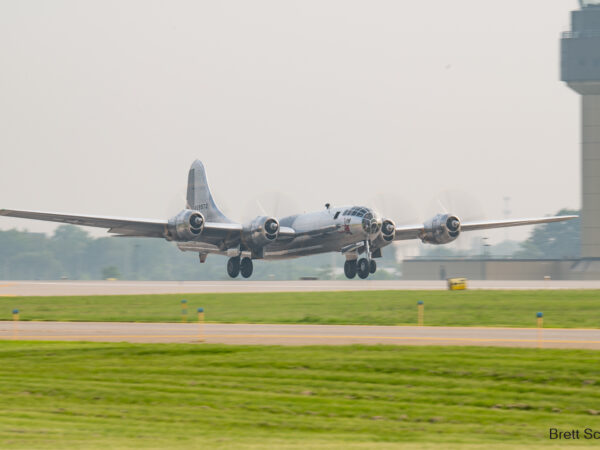
We started to reassemble The Warrior that Refused to Die.
Doc's fuselage went back together, one section at a time. Each section
was stripped with only certain components needed to keep her alive still
attached. But now the once lifeless body was taking on the resemblance
of the Superfortress; each day Doc had a little more life added.
Nothing went back into this airplane unless it had been recertified,
rebuilt or new this included all the tubing, wiring, hoses and power and
flight control cables. Don't forget that it was also per engineering
drawings.
The airplane and project was moved yet once more into another Boeing
hangar, but this time a lot of the airplane had been assembled, the wing
was in and each day you could sense the feeling of life in the airplane
as more and more wires, gauges, hoses, tubing, components, etc, were
being put back while the hangar had a beautiful sound of rivet guns
echoing throughout. The sound meant we were progressing on the
restoration.
Again we had to move our project. Each move was a setback of months of
relocation of the parts supply and project layout but we packed up and
went back to the Bunny Wash. It was like going back home.
It takes a while to get geared back up after each move, but we did not
stop. The restoration continued.
The vertical Fin was born and installed. The airplane was taking on the
shape of a Boeing B-29 Superfortress; it all seemed too good to be true.
BAD NEWS
We could not afford to pay to have the six engines overhauled so they
were sent back to the Bunny Wash from the over-hauler in Renton, Wash.
We also could not afford to have the company make new fuel cells, so
they are on hold.
Also we are plagued by the right rear lower spar cap that needs to be
replaced due to the last piece of corrosion in the airplane. This is a
major job, one that needs to be addressed and it will (it is in work as
of the writing).
REALLY BAD NEWS
In 2007 we received the worst possible news that we could receive Boeing
needed the hangar for business growth purposes, so we had to move out of
the Bunny Wash. The Kansas Aviation Museum, a short distance away, asked
us to bring Doc over.
The only problem with the move is that the plane would be outside as
there was no hangar. We installed all covers, tapped up all openings,
and did everything humanly possibly to protect the B-29 in his once
familiar surroundings outside.
Now Doc has been sitting out side for the past two years. Little to
nothing has been done to it because of the conditions. Please do not
read something into this that is not here our passion to see this plane
in the sky continues to grow.
We have put all our love, passion and work into this project. Volunteers
have almost 200,000 hours of work in the restoration.
We have worked through five moves and now we are looking at still one
more.
DEAD STORAGE
As bad as I hate to write this Doc is now going into Dead Storage. We
have a hangar to put the airplane in until something else becomes
available, but we will not be able to do any work on the plane.
At least this Warrior that has kept us free will be warm and safe from
the wicked Kansas weather. Please note this is a temporary stopping
point of the restoration,
Please know our Love, Family, Togetherness, and Passion for Doc
continues to grow and we will keep the candle light burning until he
flies again. We are bonded together as one.
If you have any questions, comments, etc., please call or write:
John Shark
United States Aviation Museum
Office 316-685-9972
Home 316-685-6740
Cell 316-207-4004
|